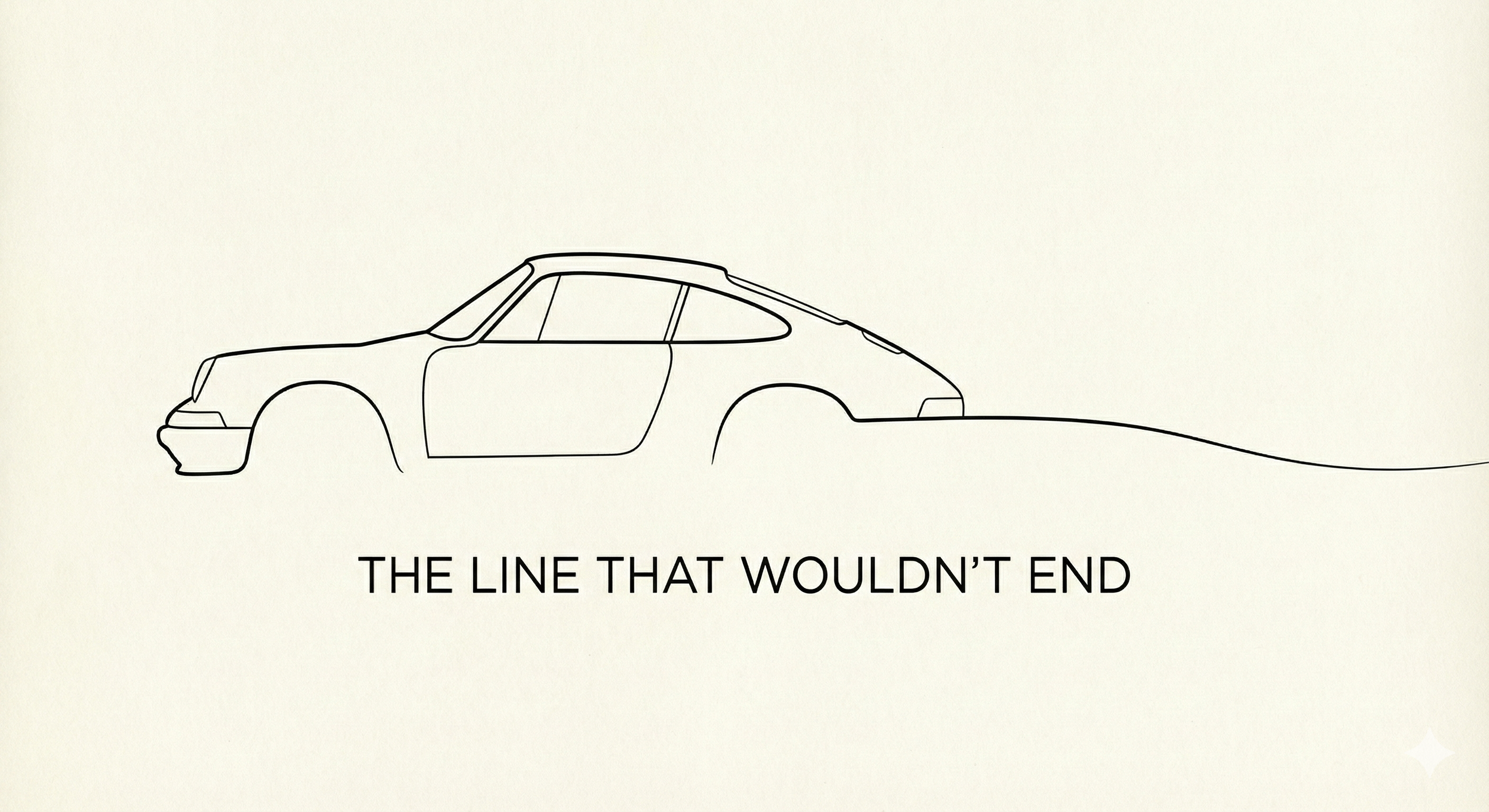
The Line That Wouldn’t End
Porsche’s story is a study in contradictions that somehow resolve into one of the most durable brands on earth: a company born from an engineering genius who willingly served a murderous regime, rebuilt in a literal sawmill, made famous by race tracks and movie stars, nearly destroyed by its own success and ego, then resurrected into a modern luxury powerhouse—only to be swallowed by the very company it once tried to take over. Through it all, one unlikely promise held: that a machine meant to thrill could also be the machine you drove every day.
In October 2008, a strange kind of victory began to feel like suffocation.
For years, Porsche had done what it always did best: take something that seemed impossible—an ungainly engine layout, a collapsing business, an industry that kept telling it “no”—and brute-force it into reality with conviction, ingenuity, and a taste for risk. Now that instinct had pushed the company into finance. Not as a sideline. As a weapon.
The target was Volkswagen.
On paper, it sounded like a fairy tale told in reverse: the boutique sports-car maker buying the mass-market giant that once supplied it parts, platforms, and—most importantly—oxygen. But Porsche had money. Porsche had confidence. And Porsche, under its hard-driving CEO Wendelin Wiedeking, had a habit of turning heresy into orthodoxy.
Then Lehman Brothers collapsed. Credit froze. Fear turned the world brittle.
And Volkswagen’s stock—Volkswagen’s stock, of all things—began behaving like a cornered animal.
Hedge funds had been shorting VW, betting it would fall. A short, in its simplest form, is a wager placed by borrowing shares you don’t own, selling them, and hoping you can buy them back later at a lower price—pocketing the difference. It works beautifully until it doesn’t. If the price rises instead of falls, the short seller still has to buy shares back to return what they borrowed. When everyone tries to buy at once, the scramble can turn into a stampede. That’s a short squeeze.
By the week after Lehman’s implosion, the squeeze hit. Hard.
VW shares rocketed upward into the stratosphere. For a surreal moment, Volkswagen became the most valuable company in the world by market capitalization—a carmaker floating above oil giants and tech behemoths on a wave of pure market mechanics and panic.
In Stuttgart, Porsche’s executives should have been giddy. On paper, they owned more than half of this soaring colossus. The dream—control of the Volkswagen Group—seemed inches away.
But the share price wasn’t a gift. It was a trap.
Porsche had financed much of its Volkswagen buying spree with debt—cheap and plentiful back when the world still believed cheap and plentiful were natural laws. Now the debt sat like a ticking device beneath the company’s feet. Refinancing would be brutal. Servicing it would be worse. Selling VW shares to raise cash—normally the escape route—would puncture the very bubble propping up the price. With so few shares left trading freely, any significant selling would collapse the price and erase the only lifeline Porsche had.
For a company that had built its identity on control—control of weight, of balance, of the driver’s connection to the road—the feeling was unfamiliar: Porsche was pinned.
And watching from the Volkswagen side of the chessboard was a man who understood family, power, and vengeance as well as anyone alive.
Ferdinand Piëch.
He was the grandson of Porsche’s founder. He was also, at that moment, the chairman of Volkswagen. And he had been forced out of Porsche decades earlier in an act of family self-preservation so dramatic it still reads like myth. Now, with Porsche wobbling, he finally had the chance to deliver a lesson that would feel inevitable in hindsight.
If you come at the king, you do not miss.
To understand how Porsche ended up here—caught between debt and destiny—you have to go back to the beginning. Back before the 911. Before the brand. Before even the name was spoken the way it’s spoken now, with that soft second syllable that the family insists matters—POR-shuh, almost “Porscha,” not the clipped “Porsh” that English tongues prefer.
You have to go back to a man who never finished college, yet insisted on being called “Doctor,” and whose talent for building machines was matched only by his willingness to place that talent in the service of evil.
Ferdinand Porsche liked to design the future. He just didn’t care who used it.
In 1906, he was recruited to Stuttgart, the industrial heart that would become Germany’s Detroit. Daimler wanted him because he had already developed a reputation as one of the most gifted automotive engineers in the German-speaking world. He would spend two decades in the engineering trenches of Daimler, helping shape the young automobile industry into something formidable.
But Ferdinand had an obsession that didn’t fit Daimler’s self-image.
He wanted to build a car for the masses—a small, affordable vehicle that ordinary Germans could buy. In the United States, Henry Ford had already proved the power of mass mobility with the Model T. Germany lagged far behind. According to the account later told by analysts Ben Gilbert and David Rosenthal, only a tiny percentage of Germans owned a car in the early 1930s. Ferdinand saw not just a market opportunity but a kind of national destiny: to mobilize a people.
Daimler’s board saw something else: dilution. They made expensive cars for wealthy buyers. That was the brand. That was the business.
Ferdinand fought. He lost. In 1929, he left Daimler in a rupture that would harden into a rivalry that never entirely cooled.
Two years later, in 1931, he started his own engineering consultancy. It had one of those names that sounds like a joke until you remember Germans aren’t joking: Dr. Ing. h.c. F. Porsche Konstruktionen und Beratung für Motoren und Fahrzeugbau—Doctor Engineer (Honorary), Ferdinand Porsche, Construction and Consulting for Engines and Vehicle Building. It was a consulting shop, not a car company. A brain-for-hire.
But in Germany, in the 1930s, no industrial dream stayed purely industrial for long.
Ferdinand’s new firm was bankrolled by two partners. One was Anton Piëch, the husband of Ferdinand’s daughter Louise—a family name that would later become as consequential as Porsche itself. The other was Adolf Rosenberger, a Jewish businessman and racing driver who helped finance the young firm.
Rosenberger’s name, Gilbert and Rosenthal note, is largely absent from the legend today for a reason that tells you everything you need to know about what came next. He was arrested by the Gestapo, imprisoned, forced to flee—and stripped of his stake. Written out. The story of Porsche, even before it built a single car with its own badge, was already a story about power deciding whose names deserved to remain.
Then came the contract that would define the twentieth century of German mobility—and stain it.
In 1934, Porsche’s consultancy landed an enormous commission: design the “people’s car,” the Volkswagen. It was not a private corporate initiative. It was state policy. The patron was Adolf Hitler.
This is the part of the story that never fits cleanly into the mythology of “great companies.” It’s not ambiguous. Ferdinand Porsche wasn’t merely a man trying to survive under a dictatorship. By the account Gilbert and Rosenthal emphasize bluntly, he was a committed Nazi and a close associate of Hitler. His engineering prowess did not exist apart from his politics. It was bound to them.
The car that emerged from this relationship would become the Volkswagen Beetle, one of the most produced single-model designs in history. Hitler even went so far as to found an entire city around the factory: Wolfsburg. He called the original project the “Strength Through Joy” car, because nothing says wholesome mass mobility like fascist propaganda.
Before the war, only a few hundred Beetles were built. Then World War II arrived, and the factories turned to military production. Forced labor. Concentration camps. The machinery of the state absorbed the machinery of the car.
When the war ended, it should have ended Volkswagen too.
But history has a way of recycling even its darkest artifacts when the alternative is hunger.
Wolfsburg fell into British hands. The initial plan was to dismantle the factory and ship it back to Britain. Then the British looked at the Beetle and, in one of the great misreads of industrial history, concluded it was not commercially viable.
One man disagreed.
Major Ivan Hirst, the British officer overseeing the area, found one of the rare pre-war Beetles and drove it. He saw a different possibility: not just a car, but a tool for rebuilding Germany’s economy in the shadow of the forming Cold War. West Germany, sitting on the fault line of the Iron Curtain, needed revitalization fast.
Hirst convinced his superiors to keep the plant running and secured an order—20,000 Beetles for British military use. A seed order. A restart. In effect, Volkswagen was refounded not by Hitler but by a British officer who believed that if people could work, they might not turn to something worse.
That act—pragmatic, morally complicated—would echo through Porsche’s next seven decades.
On the Porsche side, the war’s end looked different.
Ferdinand Porsche and Anton Piëch were arrested by the French as war criminals. They spent two years imprisoned. The founder’s son, Ferry Porsche, was also detained but released sooner—six months after the war.
Ferry was not his father. He did not have the same political gravity in the public story, though the family’s entanglements with the regime remained inseparable from their fortune. What Ferry did have was a designer’s sensitivity to feel—and a conviction about what a car could be.
He returned to Austria, to the family’s rural refuge in Gmünd, where Porsche’s elite engineering crew had been relocated during the war to avoid Allied bombing. They were operating out of a sawmill.
A sawmill.
It sounds like a metaphor too obvious to be true: the great sports-car maker reborn among timber and dust. But that’s what made it so important. Porsche wasn’t reborn in a gleaming lab. It was reborn in improvisation—people with talent, limited materials, and the stubbornness to make something refined anyway.
At first, they did repairs. Like Sony in postwar Tokyo fixing radios, Ferry’s team fixed whatever vehicles they could find. The problem, as Rosenthal puts it with deadpan irony, was that rural Austria didn’t have many cars.
So Ferry built one.
During the war, he had driven a Volkswagen Beetle modified with a supercharged engine. A supercharger is essentially an air pump driven by the engine itself; by forcing more air into the cylinders, it lets the engine burn more fuel and make more power. What Ferry loved wasn’t just speed. It was the sensation of power in a small, light car.
Years later, in a 1972 interview, Ferry captured the philosophy that would become Porsche’s core: “If you had enough power in a small car, it is nicer to drive than if you have a big car which is overpowered… On this basic idea we started the first Porsche prototype—to make the car lighter and to have an engine with more horsepower.”
It wasn’t “luxury.” It wasn’t even “sports car,” not in the prewar sense of giant engines and long hoods. It was a new idea: performance through balance.
The first production Porsche would be the 356, built from a cocktail of Beetle-derived parts and Porsche ingenuity. The Beetle’s layout—a rear-mounted, air-cooled engine—was unconventional, and it was part of the magic. Air-cooled means the engine is cooled by airflow rather than liquid coolant, which simplifies design but imposes different engineering limits. Rear-mounted means the weight sits over the driven wheels, which can improve traction but makes handling tricky at the edge. Most companies avoided it.
Porsche leaned into it.
The 356 was expensive for postwar Europe, yet it found buyers. Not because it was practical in the conventional sense, but because it offered something rare: a car that felt alive.
And then Porsche did something that, in hindsight, looks like a masterstroke of brand-building—but at the time was simply a rational way to prove quality: it raced.
Racing in the early 1950s was not the hermetically sealed, astronaut-level specialization of modern Formula 1. The line between road cars and race cars was blurry. Ordinary enthusiasts competed. Movie stars like James Dean and Steve McQueen didn’t just act like racers; they raced.
At Le Mans—the legendary 24-hour endurance race in France, where reliability matters as much as speed—Porsche’s cars began winning their class. Le Mans isn’t just a sprint; it’s an engineering trial by exhaustion. If a car can survive a day of punishment at speed, it can survive a commute.
Porsche’s early racing success created the feedback loop that luxury brands dream of: proof that wasn’t marketing. It was performance observed in public.
In the words Ferry Porsche would later use to define the company’s ideal, Porsche built “the only car that can go from an East African safari to Le Mans, then to the theater, and then to the streets of New York.”
That sentence did more than describe a product. It described an identity: prestige that didn’t need fragility.
But Porsche’s survival wasn’t powered only by philosophy and racing. It was powered by an arrangement so lucrative it borders on absurd.
After Ferdinand Porsche and Anton Piëch were released from prison and the family regrouped, Volkswagen came knocking. The new, British-restarted VW still needed engineering help. Porsche, in turn, needed stability.
The deal that followed stitched the companies together for decades.
Volkswagen would reinstate Porsche’s German consultancy. In return, Porsche would receive a royalty on every Beetle sold worldwide.
A royalty. On every Beetle.
As Gilbert and Rosenthal emphasize with a kind of incredulous admiration, it was a sweetheart deal on a scale few founders ever see. At the time, no one could fully predict how global the Beetle would become. But even without perfect foresight, the structure was extraordinary: Porsche, a tiny sports-car maker, would siphon money from one of the most produced vehicles on earth.
The family split responsibilities. Ferry returned to Stuttgart to run the manufacturing and engineering side. Louise stayed in Austria and—after Anton Piëch died in 1952—built what would become one of Europe’s largest car dealership networks. Two empires, both fed in different ways by Volkswagen’s resurgence.
There was a deeper logic too, one Rosenthal and Gilbert frame as the invisible force behind Germany’s postwar industrial miracle: incentives.
West Germany needed growth—not just for prosperity but as a bulwark against Soviet influence. The state’s policies pushed capital back into factories and R&D rather than into private consumption. Whether or not every tax-rate detail survives academic scrutiny, the story captures a truth about Porsche’s culture: for decades, Porsche behaved like a company that had been trained not to extract cash, but to reinvest it.
It spent on racing. It spent on engineers. It spent on refining a feeling until the feeling became a religion.
By the early 1960s, the 356 was beloved—but the world had moved. New competitors emerged: the Jaguar E-Type, the Corvette Sting Ray, the Mustang. The sports car was no longer a quirky European indulgence. It was a category.
Ferry knew the company needed a successor. The next car would decide whether Porsche was a moment—or a lineage.
The design work fell to Ferry’s son, Ferdinand “Butzi” Porsche, the founder’s grandson, a gifted stylist with the family name and the family eye. Engine development was driven by another Ferdinand: Ferdinand Piëch, Louise’s son, a brilliant young engineer whose intensity would later become legend.
The plan that emerged was not a safe evolution. It was a declaration.
The prototype was called the 901.
And then, in one of those almost comic accidents that shape corporate history, Peugeot objected. Peugeot owned the trademark for three-digit car names with a zero in the middle—x0x. So Porsche renamed it.
The 911.
The number itself would become a brand. A shape. A silhouette you could recognize at highway speed from a half-mile away.
The engine mattered too. Porsche’s signature became the flat-six “boxer” engine, named because its opposing cylinders move like two boxers punching toward each other. The layout lowers the car’s center of gravity, improving handling. It was part of Porsche’s broader fixation: balance over brute force.
The 911 sold. Not cautiously. It sold like a company discovering its true face.
Porsche introduced a cheaper sibling, the 912, to bridge the price gap: essentially a 911 body with the older four-cylinder engine. It was a stopgap, but it revealed something crucial about Porsche’s business: the expensive version carried the margins; the accessible version carried the volume and the future fandom.
Porsche still needed a true entry-level car. So it turned to Volkswagen again.
The joint project became the 914, a mid-engined roadster. Mid-engined means the engine sits behind the driver but ahead of the rear axle, a layout that can deliver near-perfect weight distribution—“how God intended sports cars to be,” Doug DeMuro would later say, half-joking and wholly sincere.
The 914 worked. It sold more than the 911 for a time.
And yet, as the 1970s arrived—with oil shocks, regulations, and shifting tastes—the very success of the strategy created a new problem: succession.
The family had too many geniuses. Too many heirs with legitimate claims. Butzi had designed the 911. Piëch had engineered its heart and managed the Volkswagen relationship. Ferry was aging. Louise had her own empire. The company’s future was becoming a question of bloodline politics.
Then came a moment so startling it feels like the kind of plot a novelist would reject as unrealistic.
In the fall of 1970, Ferry and Louise convened a family summit. Rather than choose one Ferdinand over the other, they chose something else entirely: the family would exit day-to-day management.
Not because they were failing. Not because they lacked talent. Because they wanted peace.
As Rosenthal notes, Ferry would later admit—carefully—that perhaps there had been better solutions. But the decision meant the family could be family again. Birthdays without war councils. A name shared without constant combat.
Porsche would still be owned by the family. It simply would no longer be run by them.
The result was a corporate experiment in self-denial: removing the very people who had made the company.
Butzi left to form Porsche Design, a licensing-driven design business that would put the Porsche name on sunglasses and accessories—an echo of how other luxury dynasties monetize a surname when the factory doors close to them.
Piëch did not leave quietly.
First, he tried consulting. Then Volkswagen—recognizing what Porsche had just thrown away—pulled him in.
At the time, Audi was not the sleek, aspirational German rival it is today. DeMuro describes it as a second-tier brand, closer in perception to a curiosity than a status symbol. Piëch made it serious. Then, in 1993, he became CEO of Volkswagen itself. He expanded the group, bought and revived brands, and built a reputation as the iron-fisted executive of a century.
Porsche, meanwhile, entered its wilderness.
The first non-family CEO, Ernst Fuhrmann, had deep history—one of the engineers from the sawmill days. But being an engineer is not the same as being a strategist.
Fuhrmann killed the 914 and pursued the 924, a front-engined, water-cooled car—heresy to Porsche purists who saw rear engines and air cooling as sacred. Water cooling, of course, uses liquid coolant and radiators; it can support higher performance and emissions compliance, but it felt like capitulation.
Then Fuhrmann committed what would later look like the most unimaginable sin: he tried to replace the 911.
The replacement was the 928, a front-engined V8 grand tourer. In context, it wasn’t insane. The 356 had been replaced. The 911 was aging. Regulations were tightening. Competitors were getting bigger and more powerful. It was reasonable to wonder whether the rear-engined 911 had an expiration date.
But Porsche’s culture was built around the 911 now, and the thought of its death crushed morale.
Then, in one of the most famous scenes in automotive corporate lore, an American arrived.
Peter Schutz, a new CEO with the outsider’s willingness to violate German inevitability, toured the engineering offices. In Helmut Bott’s room—the head of engineering—there was a timeline charting product lifecycles. The 911’s line ended. Its end had been planned.
Schutz took a marker, stood, and drew the line forward—past its scheduled death, across the board, onto the wall itself.
Then, according to the story Porsche people told for decades, he turned to Bott and said: “Do we understand each other?”
For years, it sounded too perfect to be true—a morale-boosting myth. But DeMuro, who worked at Porsche and befriended Porsche North America’s general counsel, later learned that someone asked Schutz directly, at his home in Naples, Florida. Schutz insisted it happened. And Bott, he said, “was grinning like the Cheshire Cat.”
The 911 would live.
But saving the soul of the company didn’t automatically save the company.
By the late 1980s and early 1990s, Porsche had become a mess of aging platforms and strategic confusion: the 911 (by then known internally through its changing project codes), the 928, and the entry-level line that evolved from 924 to 944 to 968. Meanwhile, Japanese manufacturers were building modern, powerful sports cars at aggressive prices, and currency swings made German imports painfully expensive in the U.S.
Sales cratered. In the early 1990s, Porsche’s U.S. deliveries fell to levels worse than the mid-1960s. The company’s market value collapsed so far that analysts spoke openly about a near-certainty that the family would have to sell.
So Porsche did what proud companies do when pride breaks: it took contract work.
It built the Mercedes-Benz 500E in its own factory. It helped Audi create the RS2—a high-performance wagon that DeMuro notes helped ignite Audi’s later obsession with fast wagons. These deals weren’t glamorous. They were oxygen masks.
And then, in 1993—the same year Piëch took the helm at Volkswagen—Porsche appointed a CEO who understood both humiliation and manufacturing truth.
Wendelin Wiedeking had joined Porsche in the 1980s, protested the company’s direction, and left. Now he came back first to run production, where he implemented the Toyota Production System—a disciplined approach to manufacturing that emphasizes continuous improvement, reducing waste, and building quality into every step rather than inspecting it at the end. In an industry where margins can vanish into inefficiency, it can be the difference between survival and collapse.
Then he became CEO.
Wiedeking’s first moves looked almost like surrender. He cut. He simplified. He killed the sprawling product strategy until Porsche was essentially a one-product company again: the 911.
Asked about an entry-level Porsche, he delivered the kind of line that makes executives legends: “Porsche’s strategy for an entry-level Porsche is a used Porsche.”
But this wasn’t minimalism as an end state. It was triage.
Once the patient stabilized, Wiedeking rebuilt the product line with a new logic: Porsche would no longer share its entry-level soul with Volkswagen. It would share it with itself.
The new car was the Boxster, a mid-engined roadster that borrowed heavily from the 911’s front end and interior. This was not only brand strategy—making the cheaper car feel like a real Porsche—it was manufacturing strategy: shared parts meant shared costs, shared tooling, shared profitability.
The Boxster worked. It created new buyers without announcing them as second-class.
Then Wiedeking made the move that, even now, still feels like it should have diluted the brand: he built an SUV.
The Cayenne.
When the first Cayennes appeared, people scoffed. Porsche, the sports-car company, building a family hauler? It sounded like a desperation play, or a cynical cash grab.
Porsche’s own executives didn’t fully understand the category at first. DeMuro recalls internal conversations so earnest they sound almost quaint: should the American market want… a gun rack option? Early Cayennes even offered off-road hardware—transfer cases, air suspension, capabilities far beyond what most luxury SUV buyers actually used. Porsche, not yet knowing which kind of SUV the market truly wanted, built one that could do everything.
It was heavy. It wasn’t pretty. It sold anyway. Then it sold more. Then it became the profit engine that ensured Porsche’s sports cars could remain true instead of becoming desperate.
And Porsche did something else at the same time—something that protected its mystique while it printed money.
It built a halo.
The Carrera GT.
A carbon-fiber supercar with a screaming V10 derived from abandoned racing projects, a manual transmission, and minimal driver aids—what DeMuro calls a “true analog supercar.” It was a car that demanded competence. It carried danger in its reputation and, after high-profile tragedies, in its mythology. But in brand terms, it did something invaluable: it told the world Porsche hadn’t become a minivan company with a crest.
The Cayenne brought revenue. The Carrera GT brought legitimacy.
In luxury, this is the dance: offer accessible entry points without conceding the ceiling. Louis Vuitton sells wallets and also sells objects so expensive they serve primarily as proof of seriousness. Porsche, as Gilbert observes, became “Louis Vuitton” in operational scale—hundreds of thousands of units—while retaining something like Rolex’s ethos: steel meant to be used, not locked away.
By the mid-2000s, Wiedeking’s Porsche was no longer struggling. It was thriving.
Market cap exploded from near nothing to tens of billions. Operating profit surged. New models arrived: the Panamera sedan, tailored in part to markets—like China—where four doors signaled status. The Macan would later become a blockbuster compact SUV. Porsche had transformed itself into a modern luxury machine.
And then the company ran into a problem that only the successful have: too much money, too few places to put it.
German corporate culture, as the story is told, had long favored reinvestment. Now Porsche had reinvested. It had expanded. It had built factories. The question became: what next?
Wiedeking looked across the industrial landscape at his most important partner—the one whose parts and platforms underpinned his SUV ambitions—and he made the leap from partnership to conquest.
If Volkswagen was the foundation beneath Porsche, then owning Volkswagen would make Porsche unassailable.
So Porsche began buying VW shares. Quietly at first. Then more aggressively. Then using derivatives and options—financial instruments that let you control exposure to shares without always owning them outright, a technique that can magnify control while postponing disclosure.
There was even a law designed to prevent takeovers: the Volkswagen Law, which limited how much voting power any one shareholder could exercise. Lower Saxony, the German state, retained a significant stake as a kind of national safeguard. The law’s spirit was “Volkswagen is too important to be raided.”
But the law hadn’t envisioned the raider would be family.
Porsche created a holding company: Porsche SE. Think of it as a parent entity that owned the car business and accumulated VW shares. It began loading debt—roughly ten billion euros—onto the holding company to finance the buying spree.
And here the story tightens into something almost Shakespearean, because Ferdinand Piëch, now the Volkswagen chairman, was also a member of the Porsche-Piëch family controlling Porsche. He sat on both sides of the boardroom table. He had motives on both sides. He could plausibly benefit no matter what happened.
Then Lehman fell. The world snapped.
And Porsche’s cleverness became its cage.
In the chaos that followed the short squeeze, Porsche could not easily liquidate shares without collapsing the price and revealing how fragile the victory had been. It could not refinance debt on friendly terms. It could not keep buying its way to the 75% threshold it needed to fully consolidate Volkswagen.
It was stranded.
That’s when Piëch moved.
Volkswagen publicly signaled that Porsche’s financial position was untenable—that Porsche, the company trying to buy Volkswagen, might not survive. Then Volkswagen offered a “solution”: it would purchase Porsche’s operating car business.
The price first floated—three to four billion euros—was a kind of humiliation, a figure that would have looked absurd months earlier when Porsche’s valuation had soared. It was Piëch demonstrating a fundamental rule of empire: when your rival is overleveraged, you don’t need to outsmart them. You just need to wait for gravity.
Within months, Wiedeking was gone. Reports held that Porsche employees gave him a standing ovation as he left—an acknowledgment of the paradox: he had saved Porsche, and he had nearly destroyed it trying to make it invincible.
Volkswagen acquired Porsche in stages, completing the purchase in 2011 for a total price around the high single-digit billions. On paper, Volkswagen bought Porsche.
In reality, the Porsche-Piëch family emerged with even more power.
Because Porsche SE still held a massive Volkswagen stake, the family became the dominant controlling shareholder of the Volkswagen Group—now including Porsche itself. They had, in effect, traded operational independence for dynastic control of an empire.
It was the oldest trick in family capitalism: lose the castle, keep the kingdom.
Today, Porsche’s contradictions are more visible than ever.
The company sells hundreds of thousands of vehicles a year. A large portion of its revenue comes from SUVs. In China, many buyers want four doors, not track days. And yet the 911 still exists, still recognizable, still aspirational. As DeMuro notes, the enthusiasm ecosystem has only intensified: Cars and Coffee gatherings that feel like Porsche gatherings; vintage prices rising; a tribal language of model codes and spec details that turns ownership into membership.
Porsche has also stepped into the electric future with cars like the Taycan—proving, to many skeptics’ surprise, that an electric performance sedan can still “drive like a Porsche.” The big question isn’t whether Porsche can build fast electric cars. Speed is increasingly democratic. Even mainstream EVs can outrun yesterday’s supercars in a straight line. The question is whether Porsche can preserve the feeling—the balance, the feedback, the sense that a driver and a machine are in conversation—when the machinery becomes silent.
And that question circles back to the most important image in Porsche’s modern mythology: an American CEO in an engineering office, taking a marker and refusing to let the line end.
When Peter Schutz drew the 911’s timeline onto the wall, he wasn’t just extending a product plan. He was declaring that Porsche was not merely a manufacturer of vehicles. It was the guardian of a particular idea of driving—an idea that could survive scandals, recessions, family wars, and even the irony of being absorbed into Volkswagen.
A line like that, once drawn, is hard to erase.
And Porsche, for better and worse, has always been a company that lives with the lines it chooses.
Ben HadleyBASIC
Ben Hadley may produce accurate information about automotive SaaS.